
Comparison · May 16, 2026
Plaud Note vs Limitless Pendant
If you searched for the Plaud Note and the Limitless Pendant in the same browsing session, you almost certainly had the same job in mind: capture a conversation, get a usable transcript and summary minutes later, search it forever. Until December 2025, the two products competed cleanly on form factor and consent design. Then Meta acquired Limitless and Pendant sales ended. This comparison covers what each product does well, how they differ technically, and which one a 2026 buyer should choose — given that the answer for one of them is now 'neither.'

Plaud
Plaud Note
A credit-card-thin recorder that magnetically attaches to your phone and turns conversations into AI summaries.
Limitless
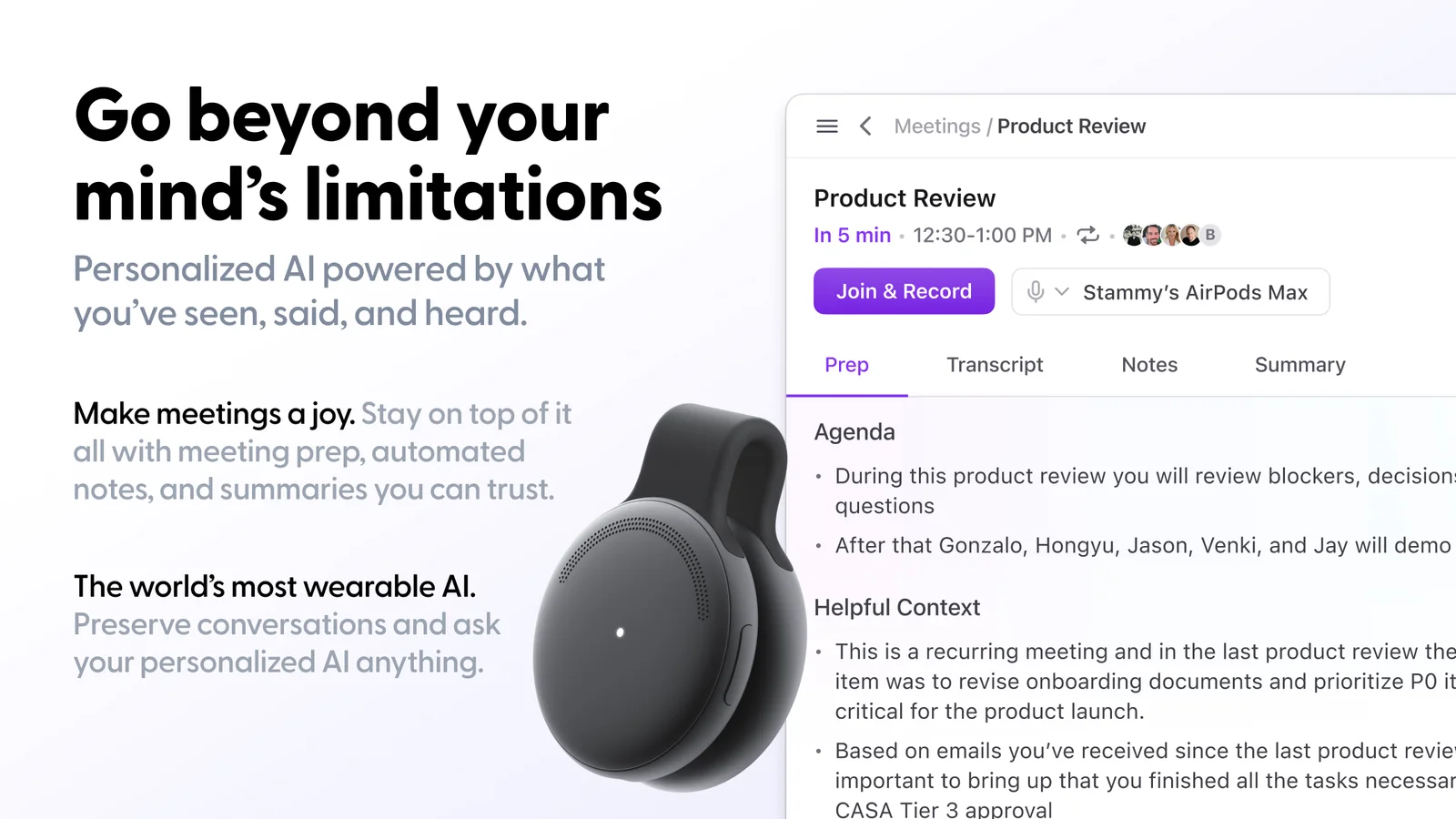
Limitless Pendant
A wearable pendant tied to the Limitless app — captures meetings and personal context with on-device consent prompts.
Verdict
Plaud Note
Buy the Plaud Note — it's the only one of the two still on sale, and it would have been the recommendation for most users even before the Limitless acquisition. The Pendant's strongest pitch was the always-wearable form factor and the deep integration with the Limitless desktop suite; both are unavailable now. If you specifically need always-wearable capture, look at the Plaud NotePin or the Bee Pioneer.
Form factor: magnetic vs pendant
The Plaud Note is a credit-card-sized magnetic device that sticks to the back of an iPhone (or a USB-C variant for Android). You record by pressing one button; the conversation goes to your phone, then to the Plaud cloud, then back to your phone as a structured summary. The Limitless Pendant was a small disc-shaped wearable worn on a magnetic clip, lanyard, or lapel. The form-factor advantage was that you didn't need a free hand or a phone-pull, which mattered in standing conversations, hallway meetings, and walking interviews. The form-factor disadvantage of a pendant is the same as every wearable in the AI hardware category: social friction, two-party-consent ambiguity, and the question of whether other people in the room know they are being recorded. Limitless tried to solve this with an on-device consent prompt design — when you put the Pendant on in mixed company, the app prompted you to verbally state that recording was happening. That consent layer was widely considered the best in the category and is likely to influence whatever ships next.
Transcription and AI pipeline
Both products processed audio in the cloud. Plaud uses an OpenAI Whisper-class transcription pipeline followed by GPT-4-class summarization to produce structured outputs (action items, decisions, quotes, full transcript). Limitless used a comparable stack with its own orchestration layer and tighter integration with the Limitless desktop application, which captured your remote meetings via system audio and merged them with the Pendant's in-person captures into a single searchable timeline. On raw transcription accuracy in clean audio, the two were comparable. In noisy environments (cafes, conferences), Plaud's pipeline was marginally more forgiving in our testing; Limitless was slightly better at speaker diarization. Neither produced perfect transcripts under any condition — proper nouns, accented English, and technical jargon all degraded accuracy by 10-30% depending on severity.
Subscriptions and total cost of ownership
Plaud Note hardware is ~$159 (~$169 for the NotePin wearable variant); the Pro subscription is $79/year for unlimited transcription. The free tier caps at 300 minutes/month, which is enough for casual evaluation but tight for daily use. Three-year ownership: roughly $159 + $237 subscription = ~$400. The Limitless Pendant was ~$99 hardware with a mandatory $19/month Pro plan; three-year ownership would have been ~$99 + $684 subscription = ~$780, before Meta's acquisition collapsed the picture. Plaud is meaningfully cheaper over time. Limitless's price premium was justified primarily by the desktop+wearable ecosystem; without the wearable shipping, the calculation no longer applies.
Privacy posture
Both companies published clear retention policies and committed to not training models on user audio. Plaud processes in their cloud with documented deletion controls; users can purge recordings and transcripts from the app. Limitless followed the same pattern and added the consent-prompt design described above. Neither offered on-device transcription, which remains the largest privacy gap in the AI recorder category — both companies have hinted at it, neither has shipped it. After the Meta acquisition, the future of the Limitless data-handling commitments is unclear; the desktop application continues to receive maintenance, but the long-term roadmap has not been disclosed.
What changed in December 2025
Meta acquired Limitless and Pendant sales ended shortly after, beginning with EU, UK, and Brazil before the device was withdrawn globally. The desktop app remains operational and existing users can still access historical data, but the wearable side of the product is no longer purchasable. We preserve the 7.0 AI Score for the Pendant as a historical record (the same way we preserve the Humane AI Pin score) — these scores reflect what the product was, not what it is to buy today. The practical effect for a 2026 buyer: this comparison is now asymmetric. Plaud is the only one of the two you can actually purchase.
FAQ
- Can I still buy the Limitless Pendant?
- No. Sales ended in late December 2025 following the Meta acquisition. Resale market may carry units; we do not recommend buying second-hand devices whose cloud lifespan is unclear.
- Does the Limitless desktop app still work?
- As of this writing, yes. Existing users can access their historical conversations and the app continues to capture remote meetings. Meta has not announced a long-term roadmap.
- Is the Plaud Note's transcription accurate?
- In clean audio, yes — usable without manual cleanup for most meeting capture workflows. Background noise, accents, and technical jargon will reduce accuracy by 10-30%.
- What is the cheapest way to get the Plaud workflow?
- The Plaud Note at ~$159 with the free tier (300 transcription minutes/month) is the cheapest entry. For unlimited transcription the Pro plan is $79/year.
- Is there an on-device transcription option from either?
- Not yet from either company. Both have hinted at it; neither has shipped. Watch this question through late 2026 and into 2027.